
Introduction
Technology has transformed the way we learn, and piano education is no exception. Today, anyone can access online piano courses, download interactive learning applications, or even use artificial intelligence (AI) tools that promise personalized piano instruction.
These solutions offer convenience, flexibility, and accessibility. Some can recognize notes, evaluate playing accuracy, track progress, and provide instant feedback. With AI becoming increasingly advanced, learning to play the piano independently may seem easier than ever.
But can technology truly replace the experience, expertise, and personal guidance of a private piano teacher?
While digital tools and AI-powered learning platforms can be useful educational resources, they have limitations when it comes to developing proper technique, understanding music, adapting to individual needs, and maintaining long-term motivation.
Whether you are considering piano lessons for your child or looking to learn the instrument yourself, understanding the differences between these approaches can help you make a more informed decision from the start.
Here are the key advantages of learning with a private piano teacher compared with relying exclusively on online programs, applications, or AI piano teachers.
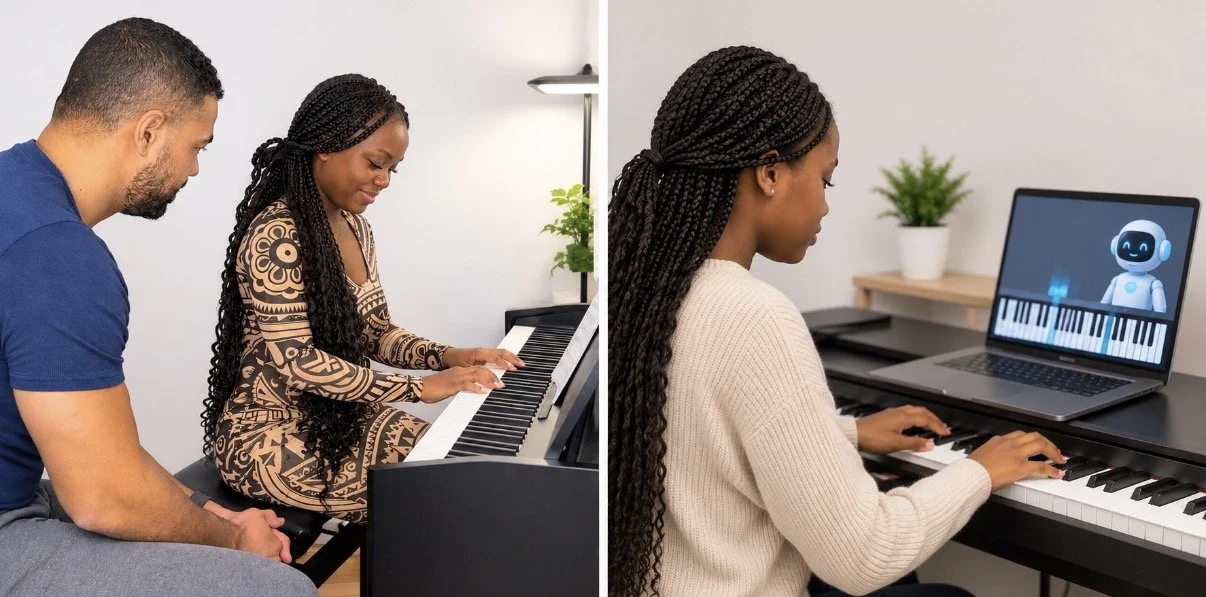
1. Personalized instruction that goes beyond algorithms
One of the greatest advantages of private piano lessons is the ability to receive instruction tailored to your individual needs.
Every student is different. People learn at different speeds, have different strengths and challenges, and respond to different teaching approaches. A program designed for a general audience cannot always accommodate these individual differences.
AI-powered piano teachers can adapt certain exercises based on performance data, identify recurring mistakes, and recommend activities according to a student's progress. However, personalization based primarily on algorithms and measurable performance is not the same as understanding the complete needs of an individual student.
A qualified private teacher can recognize when a student needs a different explanation, a more gradual approach, additional encouragement, or an entirely different learning strategy.
Instruction can be adapted not only to what a student plays, but also to how they learn, what motivates them, and what challenges they encounter. A student's age, concentration, personality, interests, previous experience, and learning preferences can all influence how a lesson should be approached.
For children, this means receiving instruction that considers their developmental stage, attention span, learning abilities, and interests. For adults, it also means progressing according to their personal objectives, musical preferences, and available practice time.
Sometimes, the best approach is to introduce a new concept. Other times, it is to revisit an earlier lesson, simplify an exercise, change the teaching method, or spend more time developing a particular skill.
Rather than simply adjusting the difficulty of an exercise, a private teacher can adapt the entire learning experience to the individual.
2. Immediate feedback, human observation, and the prevention of bad habits
One of the biggest limitations of learning through prerecorded videos and many piano applications is the absence of meaningful, individualized feedback.
Modern AI systems can analyze audio and MIDI input, identify incorrect notes, evaluate timing, and provide increasingly sophisticated feedback. These capabilities can be helpful, particularly for practicing specific exercises.
However, playing the correct notes does not necessarily mean playing correctly.
An application may recognize that a note was played, but it may not reliably assess every aspect of a student's physical technique, such as unnecessary tension, inefficient movement, hand positioning, finger coordination, or posture.
A private teacher observes how you play, listens carefully, and identifies technical or musical problems that may not be apparent through automated analysis.
More importantly, a teacher can demonstrate the correct movement, explain why a particular approach is ineffective, and guide the student through the process of improving it.
AI can help identify what went wrong, but a good teacher goes further by understanding why it happened, demonstrating how to correct it, and helping the student avoid repeating the same mistake.
Developing good piano technique from the beginning helps prevent bad habits that can become increasingly difficult to correct over time.
Human observation and personalized correction are particularly valuable because many technical problems require more than identifying an incorrect note. They require understanding the underlying cause and finding an appropriate solution.
3. Structured learning and a clear path to progress
Learning the piano involves much more than memorizing notes or playing songs. It requires the gradual development of several interconnected skills, including reading music, rhythm, coordination, technique, musical understanding, and interpretation.
Generic online programs generally follow a fixed curriculum. AI-powered platforms may offer adaptive learning paths, but their recommendations are still influenced by the capabilities, objectives, and teaching structure built into the software.
A private teacher provides a broader perspective on your musical development.
Each lesson builds upon previously acquired knowledge while introducing new concepts at an appropriate pace. Your teacher can recognize when you are ready to move forward, when additional practice is needed, and which skills deserve more attention.
A teacher can also recognize when a student appears to understand a concept but has not yet developed the ability to apply it independently.
This distinction is important. Completing an exercise successfully does not necessarily mean mastering the underlying skill.
A structured learning path ensures that students develop a balanced musical foundation rather than simply progressing through a series of exercises or application levels.
4. Accountability, motivation, and consistency
One of the most common challenges in learning an instrument is maintaining consistency.
Online programs and AI piano teachers offer flexibility and can be accessed at virtually any time. However, that flexibility can also become a disadvantage. Without a teacher, a schedule, or clear expectations, it is easy to postpone practice, lose motivation, or abandon the learning process altogether.
Having a private teacher introduces a valuable sense of accountability.
Regular lessons establish a routine, provide achievable objectives, and create opportunities to discuss your progress. Knowing that someone is following your development can encourage you to remain consistent and take responsibility for your learning.
Unlike an automated system, a private teacher can recognize when a student is losing interest, struggling with confidence, or becoming frustrated.
A teacher can adjust expectations, celebrate achievements, introduce new challenges, and provide encouragement when progress seems slow.
For children, this guidance is particularly valuable. Developing a relationship with a teacher can help establish positive learning habits, responsibility, and perseverance.
For adults, regular lessons provide structure and help turn a personal interest into a sustainable learning habit.
5. Developing real musical understanding, not just playing the right notes
Many piano applications and AI learning platforms focus heavily on note recognition, visual instructions, automated scoring, and performance accuracy. While these features can help students learn to play the correct notes, they do not necessarily teach them how to understand, interpret, and express music.
A private teacher helps students understand musical notation, rhythm, dynamics, articulation, phrasing, and expression. Students gradually learn to interpret music rather than mechanically follow instructions.
They also develop the ability to recognize patterns, understand musical structures, listen critically, and make informed musical decisions.
Although AI can explain musical concepts and generate exercises or theoretical examples, a private teacher can demonstrate how these concepts translate into actual musical expression.
For example, understanding where to apply a crescendo is one thing; learning how to shape a musical phrase naturally and expressively is another.
Music is not simply a collection of correct notes. It is an art that involves interpretation, sensitivity, creativity, and personal expression.
6. Customized practice assignments and efficient practice methods
Practicing regularly is essential, but practicing correctly is just as important.
Without proper guidance, students can spend considerable time repeating entire pieces without addressing the specific difficulties preventing them from progressing.
AI applications can generate practice exercises, identify certain recurring errors, and recommend additional activities. These features can be useful, but they do not always provide the complete context needed to determine the most effective practice strategy for a particular student.
A private teacher can identify exactly what needs improvement and provide targeted exercises and practice instructions.
Instead of simply telling you to practice a particular piece, your teacher can explain how to approach difficult passages, which sections to isolate, how to manage challenging rhythms, and how to gradually increase tempo.
Personalized practice assignments also provide direction between lessons, making independent practice more productive.
At ADoRe Academy, we place particular importance on developing smart practicing methods that help students progress efficiently and become increasingly autonomous in their learning.
The objective is not simply to practice more, but to learn how to practice better.
7. Human connection, emotional intelligence, and encouragement
Music is a deeply personal and expressive art. Learning an instrument involves emotions, creativity, curiosity, and the satisfaction of overcoming challenges.
This is where the human dimension of private piano education makes a particularly important difference.
AI can simulate conversation, answer questions, and provide encouraging messages. However, it does not establish a genuine human relationship or experience the student's learning journey in the same way a teacher does.
A private teacher can recognize subtle signs of frustration, hesitation, excitement, or loss of confidence. They can adjust their approach, offer reassurance, change the direction of a lesson, or find a different way to explain a difficult concept.
A teacher can also share musical experiences, demonstrate interpretations, and inspire students through genuine enthusiasm and personal artistic expression.
This connection can make a significant difference in maintaining motivation, especially during the inevitable moments when learning becomes challenging.
For younger students in particular, having a supportive and encouraging teacher can make piano lessons a much more positive and meaningful experience.
Are Online Piano Programs, Apps, and AI Teachers Completely Useless?
Not at all!
Technology has an important place in modern music education. Piano applications, online tutorials, and AI-powered learning platforms can be valuable educational tools when used appropriately.
They can help track certain aspects of performance, and make supplementary practice more engaging.
AI can also be useful for answering theoretical questions, and providing additional explanations when students are studying independently.
These tools can complement a teacher's instruction and offer opportunities for additional practice outside lesson time.
However, they are best viewed as supplements to a well-structured learning experience rather than complete replacements for personalized human instruction.
The most effective approach is often to combine the convenience of technology with the expertise, judgment, and personal guidance of a qualified piano teacher.
Why choose ADoRe Academy for your piano education?
At ADoRe Academy, we believe that every student deserves an educational experience adapted to their individual needs, abilities, and goals.
Our private piano lessons combine personalized programs with structured learning and practical methods designed to make progress more efficient and meaningful.
When learning with us, you benefit from:
Personalized learning programs: A structured learning experience adapted to your abilities, learning pace, interests, and musical objectives.
Smart practicing methods: Practical strategies that help you overcome difficulties and make better use of your practice time.
Customized homework lists: Clear assignments that provide direction, improve comprehension, and encourage accountability between lessons.
Individual attention: Direct feedback, demonstrations, and corrections to help develop proper technique and good musical habits.
A structured approach: A progressive learning path that builds a solid musical foundation while allowing room for individual interests.
A supportive learning environment: Personal guidance, encouragement, and constructive feedback throughout your musical journey.
A focus on independence: The knowledge and skills needed to become a confident, self-sufficient musician.
Whether you are introducing your child to music or pursuing a personal passion as an adult, our objective is to make your learning experience both enjoyable and productive.
The best investment is in the quality of your learning
Learning an instrument is a journey that requires time, patience, and consistency. A qualified private piano teacher offers something that technology alone cannot fully reproduce : an experienced human educator who understands the student, adapts instruction to individual needs, provides meaningful feedback, and guides the development of both musical and personal skills.
Ready to discover a smarter, more personalized way to learn to play the piano? Book your free consultation with ADoRe Academy and discover how the right guidance can transform your musical journey.
